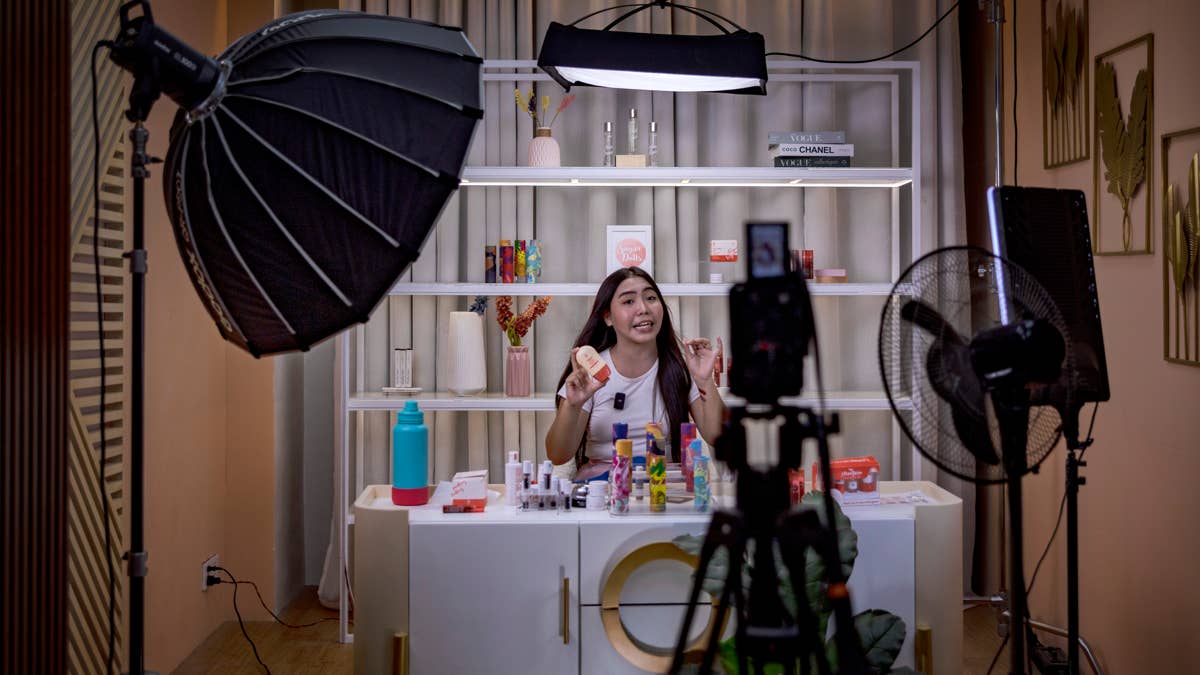
If you've ever been scrolling TikTok and landed on a Live, it can be a little jarring. Why is everyone yelling? Are these products actually legit? (Usually, yes.) The world of live shopping is vast, and TikTok is just one part of it, albeit a big one. U.S. livestream e-commerce sales hit $14.64 billion in 2025 after a nearly 50% growth surge. Brands know they need to be in the space but the problem is, how?
Marketing and sales teams are stretched thin. Budgets are tight. The top beauty brands on TikTok Shop are part of huge companies, such as Medicube, Tarte Cosmetics and Phlur. How are indie brands with small marketing budgets and a skeleton crew supposed to keep up? We spoke with live shopping experts, brand founders and marketing executives to find out exactly how they're making it work.
Community Comes Before Conversion
Sales are obviously important, but real numbers can take time. Many brands look at a live-selling platform as a community-building channel instead of just a sales one.
"For us, it really comes down to meeting the Soshe customer where she already is, and right now, that’s on TikTok and Amazon," Sahar Rohani, co-founder and CEO of Soshe Beauty, tells Fashionista. "Our community is super engaged, and they usually want to understand the formula, performance, shades and application before making a purchase. Live selling has given us the space to have those conversations in real time."
The importance of "edutainment" — the blending of education and entertainment — came up in every conversation we had with brands. Live selling gives more room for that type of content than any other platform. "People want to know, 'Is this actually going to work for me?'" Rohani continues. "Live selling gives us a chance to answer that question directly. People leave, tell their friends and family about Soshe, and often come back to the next stream. That sort of connection is hard to replicate on other paid channels."
@soshebeauty The eyeliner that went viral for a reason: An ultra-precise design, long lasting formula, and 4 wearable shades we can’t get enough of 👀 #eyeliner #makeup
♬ original sound - SOSHE Beauty
Shaina Rainford, CEO and founder of Bask & Lather Co., also knows immediate sales aren't the only metric. The hair-care brand has had success on TikTok Shop live selling thanks to her ability to look at both short- and long-term results. "Sales matter, but so do engagement, customer acquisition, audience growth, repeat viewership and the quality of customer interactions," she says. "Many purchasing decisions happen after the live has ended, so we evaluate the broader impact across the customer journey rather than focusing only on same-day conversion."
All brands emphasized that a successful Live isn't necessarily the one with the highest same-day revenue. Engaged, repeat viewers, questions asked, follower growth and product education are also important to look at.
@baskandlatherco We're LOCKED IN 🔒with how thoroughly the Scalp Therapy System balances and cleanses the scalp. Made for all hair types and textures for a healthier hair foundation.🫧💛 #ScalpTok #ScalpCare #HairTherapy #BaskAndLather
♬ original sound - Bask and Lather Co
While many indie brands are using livestreams to build community on smaller budgets, larger digital-first brands like AprilSkin have also embraced the format at scale, but with a bit of a different approach. Thanks to the backing of a larger parent company (APR, which also owns Medicube) and greater marketing resources, the brand can invest more heavily in creators to tell its product story.
According to AprilSkin, creators have been an "efficient marketing investment," but that doesn't mean it's been easy. There's a strategy to finding creators who bring an authentic voice to your brand and provide that "edutainment" at the same time — which has been AprilSkin's biggest win so far.
Creator affiliates can help brands of all sizes reach new audiences, but they're not a hands-off solution. Brands still have to recruit creators, train them on the products, provide creative guidance, monitor performance and nurture those relationships over time. This could even include expensive gifting, fancy trips, large affiliate commissions and exclusive deals. For lean marketing teams, that work can be even more resource-intensive than hosting Lives themselves.
They Treat Live Selling Like Its Own Job
There are agencies that you can hire to do all of the TikTok Shop work for your brand, from planning and strategizing to hosting lives and creating community. But most brands we spoke with couldn't afford to go down that route. "When we were discussing activating live selling as a real channel for Soshe, we interviewed with a few agencies," Rohani says. "To put it bluntly, it was incredibly expensive and the numbers didn’t work out for our price point and our assortment size."
They instead decided to learn just by doing the work and seeing what fit. "At some point, almost everyone on my team has hosted a live," she says. "We’ve also worked with our brand reps and makeup artists, and now we’re beginning to interview hosts who specialize specifically in live selling."
Rohani hosts some of the brand's Lives herself, but as CEO, she can't dedicate all of her time to the channel. The same is true for Mikayla Nogueira, influencer and founder of Point of View Beauty. While the brand has seen major success on Nogueira's TikTok Live channel, it recently hired a dedicated social commerce manager, underscoring how quickly livestreaming has evolved into a full-time function that requires in-house expertise.
"They will actually be creating content for us, being the face of the live and helping us build live sets in the new L.A. office," says Annabel Prouty Bailey, Integrated Marketing and Brand Partnerships at Point of View Beauty. "We hired someone who has that content creation background, but understands affiliate and influencer and how to sell on socials." They also brought on a vice president of education to lend their product expertise. This team will help grow POV's own account so the brand won't have to rely on its founder. "It will also give a little bit more nimbleness to be able to go live whenever, because Mikayla is so busy," Bailey adds. "She can't be going live all the time."
@pointofviewbeauty chill it is here. 🧊 cooling. weightless. deeply hydrating—it's a breakthrough you can feel. how will you chill it?
♬ Upbeat Funk - FASSounds
Of course, adding personnel isn't always possible. One brand consultant told us that a beauty company she worked with joined TikTok Shop but ultimately did little with the platform because its small marketing team was overwhelmed. Without the budget to hire dedicated support, the company wasn't able to fully invest in livestream commerce or generate meaningful sales. According to the people we spoke with, this isn't an unusual situation.
Success in live selling isn't about the fancy studio or the celebrity endorsement. Consistency is the biggest hurdle, and something that came up in every brand conversation. "Building an audience that regularly returns requires ongoing planning, training, content development and operational execution," Rainford says. "Live commerce rewards brands that show up consistently over time rather than treating it as a one-off campaign."
Rohani echoes that sentiment. "The livestream itself is only a small part of it," she says. "There's training, coordinating inventory and offers, promoting the event ahead of time and then reviewing what worked afterward. As a small team, that time investment is significant, but we've found it's worth it because literally every Live teaches us something new about our customer."
Several founders said they wish people realized that livestream commerce isn't simply turning on a camera and hoping products sell, or simply joining TikTok Shop.
"Today’s consumers don’t just care about what a brand or creator is selling — they care about who is behind the brand or product," says Ajay Salpekar, head of beauty at TikTok Shop. The company, which offers free resources, support teams and creator-selling matchmaking events for sellers, says that "success requires investment in credible hosts, useful content, the right products and reliable operations." It stresses the need for authenticity, unfiltered footage and — there's that word again — consistency.
That's also because, as Salpekar points out not every Live is going to be successful — and it doesn't have to be. "Even smaller streams help you understand your customers, answer their questions and build trust over time," he says. "Those relationships are what drive long-term growth."
They Borrow Audiences Before Building Their Own
Brands that don't have the time or budget to invest in TikTok Shop, Amazon Live or Whatnot — or to pursue traditional television shopping channels like QVC and HSN — can also look at alternative options, like Covet by Christos. Christos Garkinos launched the business as an Instagram Live show during the pandemic lockdowns before expanding it into a broader live shopping platform. His background as co-owner of famed Los Angeles luxury consignment boutique Decades gave him credibility in the luxury resale space, along with an audience of potential customers.
According to Kelly Atterton, longtime beauty editor, brand consultant and Covet by Christos beauty lead, the unique network appeals to brands that don't want to — or can't — build their own livestream infrastructure. Instead of hiring dedicated TikTok Shop employees or producing their own shows, brands can appear on an established livestream channel with an existing audience.
"For emerging brands, borrowing an established community can be much more effective than trying to build one from scratch," Atterton says. (Though, more established indie brands have found success on the niche platform as well, including UBeauty, Dr Diamond's Metacine and Philip B.) "It allows founders to focus on telling their story while tapping into an audience that's already engaged." This way, founders don't also have to be salespeople. They don't have to be experts in live-selling. They just have to educate the audience, and the Covet by Christos host helps with the rest.
Compared to TikTok or Amazon, the reach on the Covet by Christos Instagram page may be limited, and brands may have less overall control — but the cost of entry is smaller. "It's an easy point of entry," Atterton continues. "They make some money, reach a new, highly engaged audience and it took less than an hour out of their day."
Independent stores are also getting in on the action. Former Dior press executive Dianne Vavra opened Vavra New York in Huntington, NY, in 2024. She goes live on Instagram to showcase one-of-a-kind vintage handbags and jewelry from her brick-and-mortar store, creating community and building excitement over new releases.
Livestream commerce isn't a shortcut to overnight sales or virality, as much as certain best-selling brands can make it seem that way. It's another marketing channel that demands time, consistency and a willingness to experiment. The brands succeeding aren't only the ones with the biggest budgets or the buzziest creators. They're the ones showing up week after week, answering questions, educating customers and slowly building trust. As livestream shopping continues to grow in the U.S. and abroad, that willingness to commit may be the most competitive advantage of all.
Disclosure: The author has previously performed freelance administrative work for Atterton pertaining to Covet by Christos operations. This relationship did not influence the content of the article.
* This article was originally published here